
Reimagining the Porsche 928 Instrument Cluster
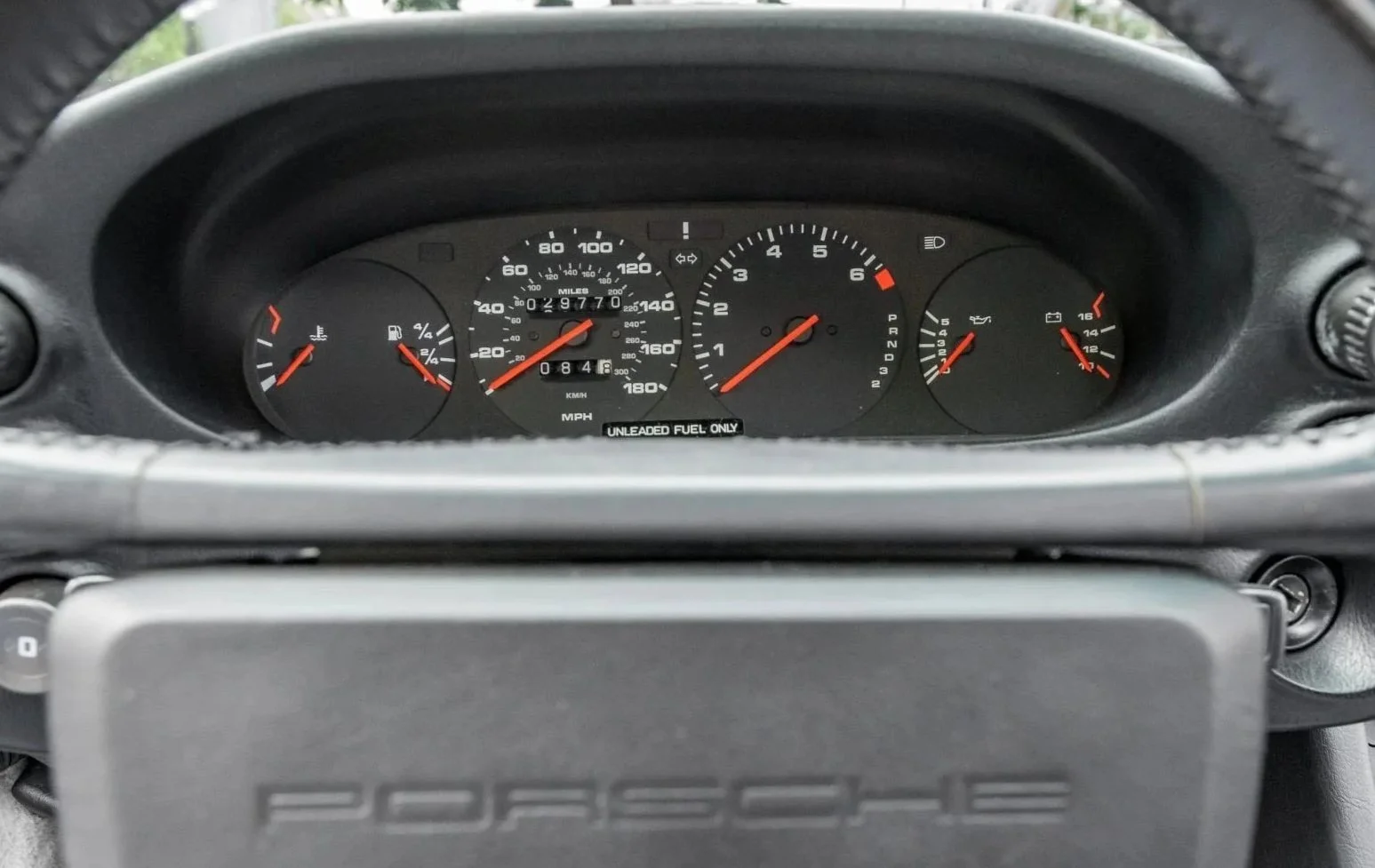
Temperature, oil pressure and battery voltage. So many more possibilities - especially if you’re trying to debug an issue
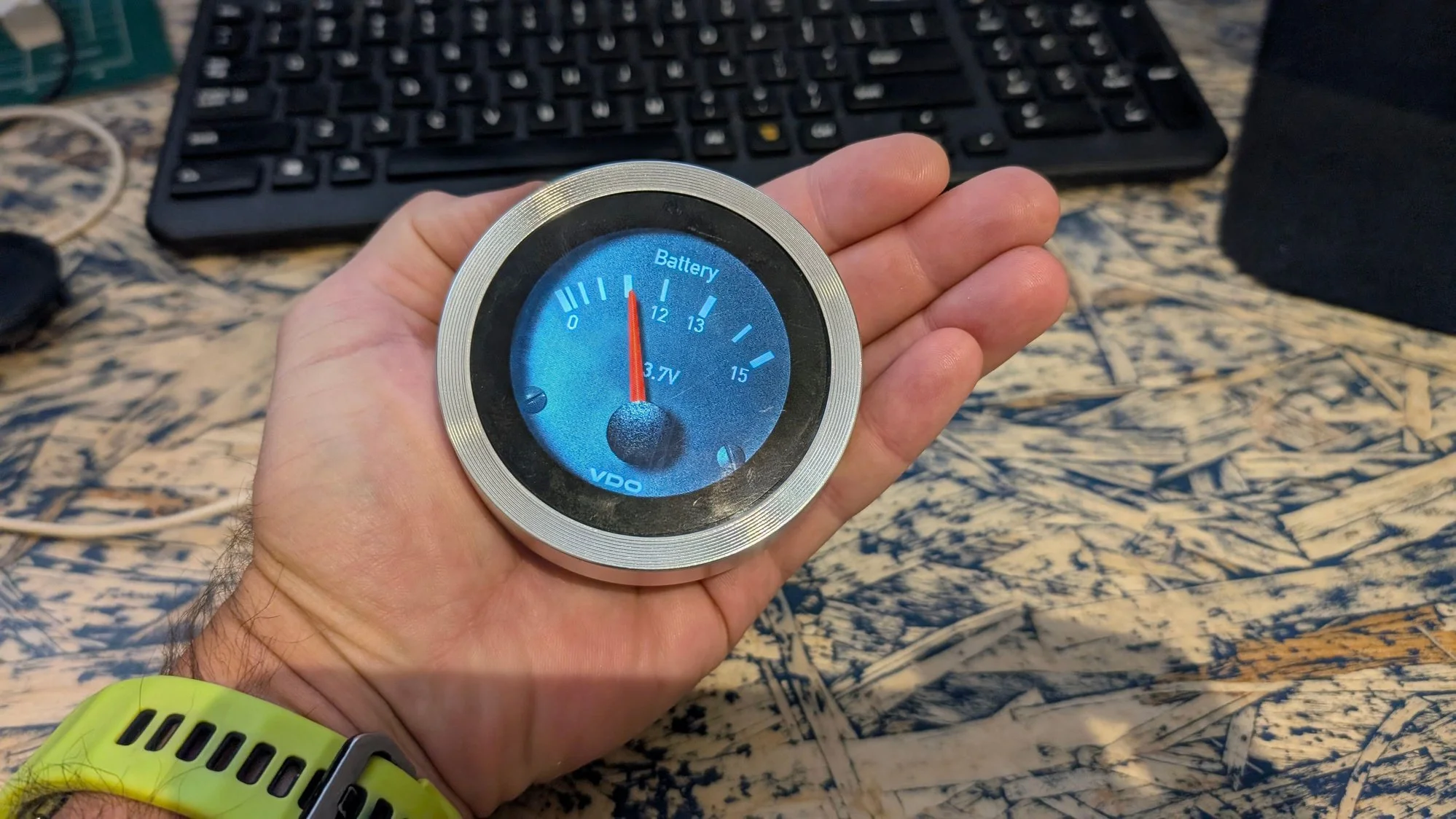
From the moment I saw this round gauge for sale, my head went to the VDO gauge pod in my brother’s 1984 Golf GTS back in the 90s. And that was it…
The Porsche 928 was engineered as a grand tourer for the future. Decades later, its shape still looks distinctive, its engineering still feels ambitious, and its cockpit still has a character that modern cars struggle to reproduce.
But the information available to the driver remains limited by the technology of its era.
At Sirius Fabrication, I have been developing a new digital gauge system designed specifically to bring modern information, responsiveness, and customization into the Porsche 928 without losing the character of the original interior.
What began as an idea for a modern gauge display is rapidly becoming a complete vehicle information system.
From Prototype to Working Hardware
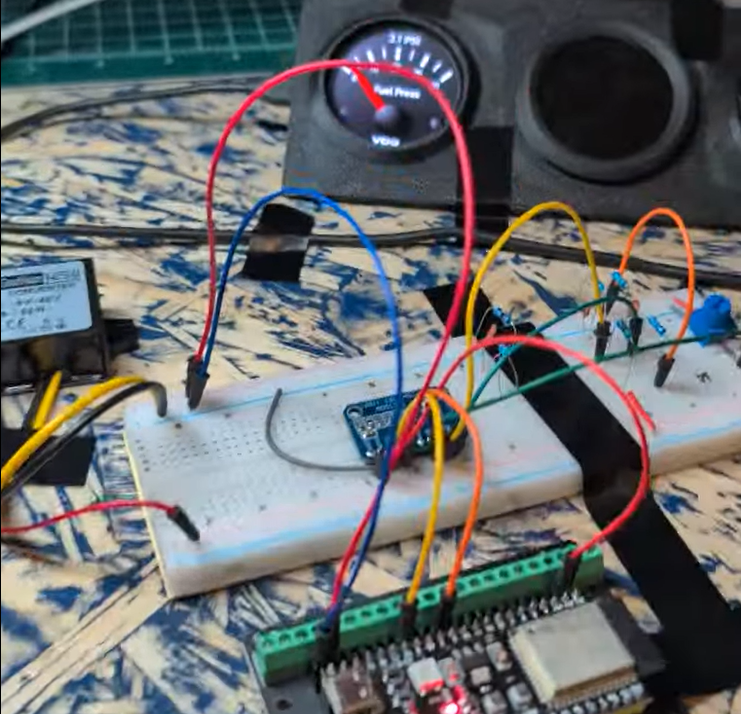
The first bench test with a potentiometer to simulate the signal from a fuel pressure sensor
The project has now moved beyond screen mock-ups and simulated data.
My current bench-test system uses two ESP32 microcontrollers communicating wirelessly. One unit collects information from the vehicle’s sensors, while the second drives the display inside the cabin.
During testing, we successfully transmitted live fuel-pressure and battery-voltage data from the sensor board to the gauge display.
To simulate the fuel-pressure sensor on the workbench, we temporarily replaced the pressure transducer with a potentiometer. Adjusting the potentiometer immediately moved the fuel-pressure gauge on the display, allowing us to test the complete signal path from sensor input to wireless transmission and final visualization.
No cable was running between the sensor board and the display.
The data was being transmitted wirelessly, in real time.
That was an important milestone. It proved that the system was no longer simply a display concept. The electronics, communication, data processing, and gauge interface were all working together.
A Faster, More Responsive Interface
A digital gauge must respond immediately. Delayed touch input, sluggish animations, or visible redraws would quickly make even an attractive display feel unfinished.
A large part of the recent development work has therefore focused on responsiveness.
The touch interface has been substantially improved, making navigation between screens feel much faster and more natural.
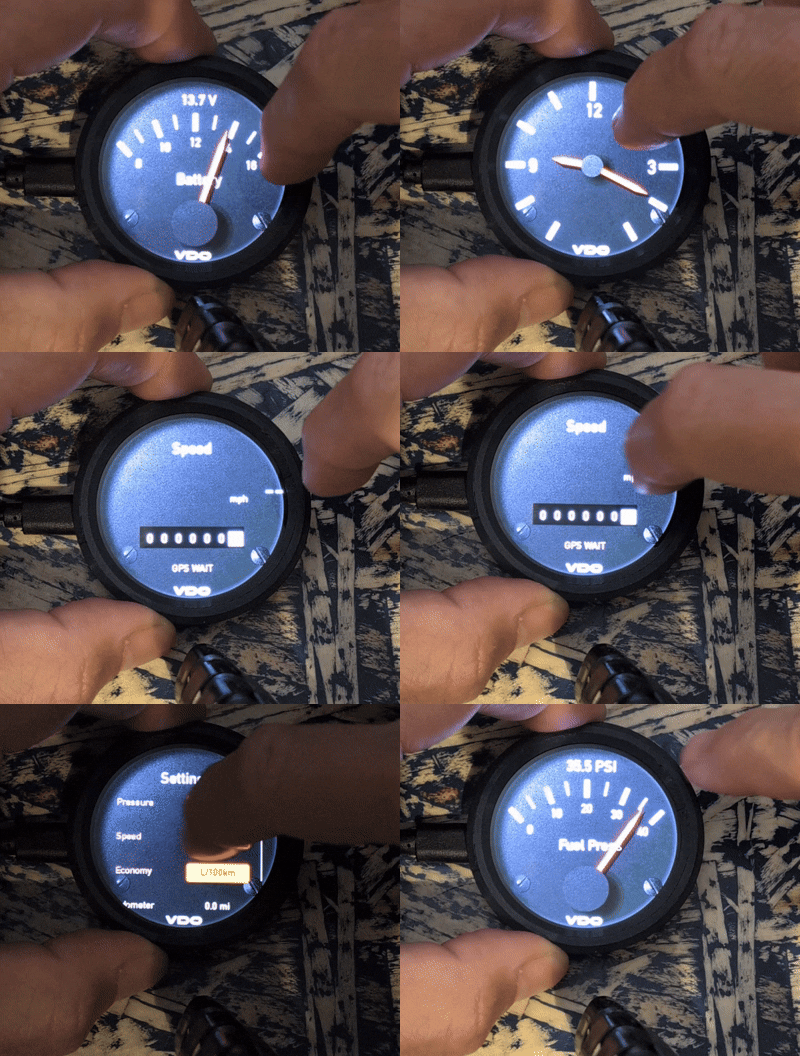
We also redesigned the way the display is rendered. The background is now shared across every screen and exists on its own underlying layer. Instead of redrawing the entire interface every time something changes, the system only updates the elements that need to move.
The gauge needles have also been redesigned. They are no longer rendered as traditional sprites, reducing unnecessary graphical work and producing smoother, more responsive movement.
These changes may be largely invisible to the driver, but that is exactly the point. A well-designed interface should feel immediate and effortless.
More Than a Pair of Gauges
The system now includes several distinct display screens.
The main gauge screens can present live vehicle data such as:
Fuel pressure
Battery and charging-system voltage
GPS-based vehicle speed
A dedicated settings screen has also been added, allowing the driver to configure how information is displayed.
Fuel pressure can be shown in either PSI or kPa. Speed can be displayed in MPH or km/h. Distance and mileage can be recorded and displayed in miles or kilometres.
These options make the system suitable for cars and owners in different markets without requiring separate hardware or software versions.
A Built-In Digital Odometer
Persistent storage is now active within the system. This allows mileage to be recorded and retained as a digital odometer, even after the display has been powered off.
The system also remembers its current state. When the car is started again, the display returns to the screen that was being used previously rather than always returning to a fixed default screen.
It is a relatively small detail, but it helps the system behave more like a finished automotive product and less like a standalone electronic accessory.
(Not only) designed Around the Porsche 928
The objective is not simply to place a generic screen inside the dashboard. The system is being designed around the 928, its available spaces, its electrical environment, and the information that is genuinely useful to its driver. However, the 80’s VDO-style is obviously not unique to the 928 - or even to Porsche. So these could realistically go in anything. It’s not difficult t change the design to something more modern or unique or OEM-style. Round and rectangular screens or varying sizes are available too, so the possibilities are endless.
Fuel pressure is particularly valuable on an older performance car, where detecting a failing pump, regulator problem, restriction, or unexpected pressure change could prevent a breakdown or engine damage.
Battery voltage provides a live view of charging-system performance and may reveal alternator, wiring, or battery problems before they leave the car stranded.
GPS speed offers an independent digital speed reading while opening the door to additional journey and performance information in the future.
Because the sensor and display units communicate wirelessly, the system can also avoid the need to route numerous individual sensor wires through the firewall and into the dashboard.
What Comes Next
Development is continuing on both the electronics and software.
Future versions are planned to support additional vehicle data, including fuel-flow monitoring on both the feed and return lines. By comparing the two flow measurements, the system could calculate actual fuel consumption rather than estimating it from engine-management data.
That creates possibilities for:
Live fuel-consumption readings
Average consumption
Trip fuel usage
Remaining-range estimates
Additional diagnostic warnings
Customizable gauge layouts
Configurable alert thresholds
The long-term goal is a modular information system that can grow beyond a single fixed gauge configuration.
In addition to fuel, sensors like wide-band O2, MAP (for vacuum), temps, oil pressure…
Building the Gauge System I Wanted for My Own 928
This project began because I wanted better information in my own Porsche 928.
Not a universal tablet mounted to the dashboard. Not a generic gauge pod. Not a display that looks disconnected from the car around it.
The aim is to create something that feels appropriate inside the 928 while adding capabilities that were impossible when the car was originally designed.
There is still development and vehicle testing ahead, but the system has already crossed an important threshold.
Live sensor data is being measured. The data is being transmitted wirelessly. The gauges are responding in real time.
The interface is faster, more configurable, and more polished with every development cycle.
The digital 928 gauge system is no longer just an idea. It is becoming a product.
Not only is the data being measured in real time, but soon it will be logged to track trends. Imagine insightful warnings like
“Your fuel pressure has been dropping over the last 90 days”.
“You vacuum has weakened compared to last month”.
“Your cranking voltage is getting low. Get your battery checked”.
Handy stuff when an OBD2 scanner is not exactly a go-to tool for a 928.
Follow Sirius Fabrication for future development updates, testing videos, and information about availability.
